Genesis of the Jade Planet
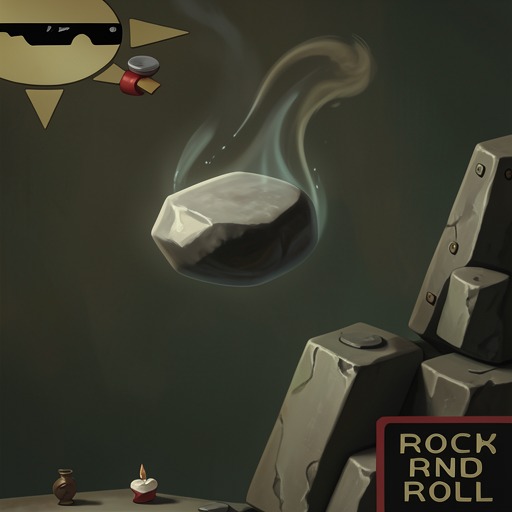
Rock Falls, Everyone DiesGenesis of the Jade Planet is the event in which the rock’s destructive planetary transformation becomes an act of creation. After accepting the merger of its Meteorite and Cultivator classes, the rock becomes a level-12 Planet, destroys much of its new world in grief, and then uses its planetary powers to remake that world as a beautiful, living, musical creation. Its decisive significance lies in the reversal: what first appears to be an ending becomes the foundation of a new world.
From Merger to Planetary Being
The immediate background is the system’s class-merge prompt. It offers to combine the rock’s Meteorite and Cultivator classes into Planet, and the rock accepts mainly to make the prompt disappear faster. The result is announced without ceremony as a level-12 Planet, followed by the beginning of the planetary fusion process. The transformation is therefore both mechanical and immense: a familiar progression-system choice changes the protagonist’s scale from individual stone to planetary body.
The new form initially exceeds the rock’s attention. It does not inspect the new numbers or watch itself grow, even as it merges with surrounding matter and becomes the largest entity it has ever been. This refusal to look is important to the event’s emotional structure. The rock gains overwhelming power before it gains the willingness to confront what that power has made possible.
Destruction and the Loss of the Old World
The newly formed planet does not immediately become a paradise. At its darkest moment, the rock realizes that it has lost two of the few things it possessed, and planetary rage follows. With unfamiliar strength and abilities it has not yet explored, it activates Gravity Cannon and flings the moon away because the moon’s gaze feels like a judgment. The oceans shift as a consequence of that act.
The rage spreads through the planet itself. The rock shatters the mountain ranges, whose destruction is bound to its memory of the quest, and sends the fragments into outer space. The catastrophe is thus not an impersonal geological accident. It is an emotional action performed at planetary scale, in which remembered places become unbearable reminders and physical geography becomes an instrument of grief. Genesis begins only after the world has been broken by the same consciousness that will later restore it.
Rebuilding the Mountain and the Rings
The rock still retains its levels and newly acquired abilities, so it turns from destruction toward experimentation. It uses Create Mountain and Sculpt Earth to raise a new mountain from the shattered ground, copying the mountain it remembers. The reconstruction is grounded in lived experience: the rock had flown over that mountain, rolled down its slopes, and waited there for hundreds of years. It knows the mountain not as an abstract landmark but as the setting of its earliest existence.
The rebuilt mountain is also tied back to the quest when the rock assigns it a name. Naming becomes an attempt to connect the new world with the lost structure of the old one, and the rock waits for the system to resolve the connection. The act does not erase the past; it gives memory a material form and asks the system, the force that has governed so much of the rock’s development, to recognize it.
The planet’s reconstruction then becomes aesthetic as well as functional. Looking at the rocks in orbit, the rock reaches for the familiar tapestry of gravity and paints patterns in the sky. The orbiting material gathers into three rings, which spin and dance in increasingly recognizable forms. Their movement awakens a faint sense of beauty, almost rhythmic, as though the rings were following a song that remains in the rock’s mind. Gravity, once chiefly a weapon and governing force, becomes a medium for composition.
Making Beauty Alive
Having become a Planet, the rock decides that becoming the best rock requires becoming the most beautiful Planet. Creation proceeds slowly across eons and millennia. The rock experiments, learns, gains levels, and develops new abilities, but the central achievement is skill: it gradually learns how to shape matter rather than merely command it.
Its first attempts at plant life are clumsy, misshapen forms resembling melted candlesticks. With time, however, the rock learns to sculpt trees from gemstones, giving them emerald leaves that ring in the wind like chimes. It raises mountains for the trees and shapes the peaks so that the wind passes through them in the right way before reaching the leaves. The landscape is engineered as an instrument. Mountain, wind, tree, and gemstone cooperate to produce music, while the three rings continue their dance above the changing melody.
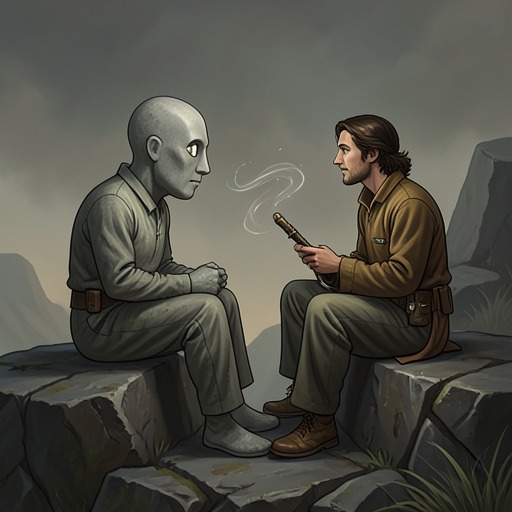
Creation expands from scenery to life. The rock thinks of people because a world that produces melodies still needs voices with which to sing. Remembering the beauty of the Jade Statue, it reaches into itself, draws out veins of jade, and begins sculpting figures before imbuing them with life. The first jade forms are small and cragged rather than perfect copies of the image in the rock’s mind. Through guidance and gradual evolution, they become shapes the rock could not have imagined for itself.
These people remain beautiful according to the rock’s stone-centered standards. They make hair from fine gemstones and polish their jade skin until it gleams in the sun. The rock does not teach them a human division between men and women; it creates a united people, and the people learn from the world around them. They begin to sing without being instructed, turning the planet’s aesthetic design into a culture capable of answering it.
The Jade World and Its Meaning
Life steadily fills the reconstructed Planet: people, animals, plants, mountains, lakes, and forests. Songs multiply, and the Planet listens to them all, rotating its rings to each tune. The creation is therefore not merely a static display of beauty. It is a responsive world in which living inhabitants generate variation, and the planetary body participates by changing the movement of its rings. The result is a community of matter, life, gravity, and sound.
The event also completes the rock’s expanding understanding of existence. Earlier, it had awakened to the Cultivator class through five hundred years of apparent stillness, and later it cast its senses outward and recognized that the planet beneath it was simply a very large rock. It then understood that the glowing celestial body in the distance was another rock, merely larger and brighter, and concluded that everything was rock all the way down, separated chiefly by scale and power. Genesis turns that realization into practice: the rock does not stand outside the world as a creator above matter, but creates by rearranging the same stone-based substance of which it, the planet, and the surrounding celestial bodies are made.
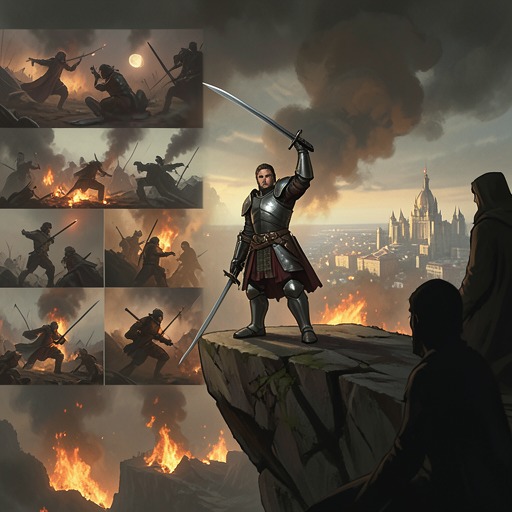
The repeated mountain-top battle openings reinforce the event’s mythic pattern. The story begins with a hero and villain preparing for grand combat, returns to the same kind of scene at A Quarry to Settle and The World Ends With Rock, and reaches Genesis after the system has repeatedly framed existence as another stage in a continuing cycle. The creation of the Jade Planet is consequently both an ending and a restart. It follows the scale of planetary destruction, yet its final movement is patient rather than explosive: a world is rebuilt over eons until it can sustain beauty, life, and song.